Reflections on the first week
The first week is over and 10 games have been played - no major shocks, but some closer games than anticipated and some sighs of relief for some nervous fans.
The first week is over and 10 games have been played - no major shocks, but some closer games than anticipated and some sighs of relief for some nervous fans.
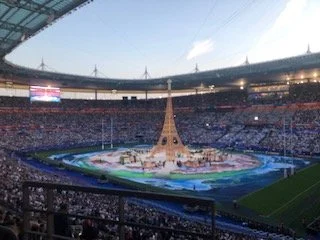
The Eiffel Tower on a rugby pitch
France, as hosts, kicked off the tournament at a rocking Stade de France with a defeat of number 4 seed, New Zealand. After an interesting if somewhat baffling opening ceremony that celebrated France’s artistic approach to life, Les Bleus survived an uneasy first half and moved ahead decisively in the second half winning 27-13. The result is unlikely to change the outlook of both teams making the quarter finals but France must be disappointed to lose their hooker to injury at the start of the event.

Anyone got a key?
The logistics of organizing events attended by eighty-plus thousand spectators at Stade de France in Paris and more than sixty thousand at the Velodrome in Marseille are not easy, and for the most part, everything worked out OK. However, a couple of issues arose during the first weekend that were surprising; spectators for the England/Argentina game in Marseille on the first Saturday queued for a long time to get into the ground. With the constant press of new fans arriving every minute it was both uncomfortable and, with steep steps involved, potentially dangerous. (The next night, for the South Africa vs. Scotland match, access to the ground was much smoother.) But perhaps more alarming to the average rugby fan was that both locations ran out of beer by half-time! Given that temperatures were much higher than usual at around 80-85F, consumption was no doubt higher, but really?
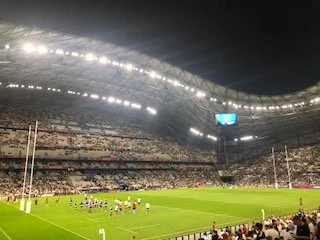
Stade de Marseille - football and rugby
But overall the facilities are fine and there isn’t a bad view in the house. It is obvious, especially in Marseille, that local support for sports including rugby is strong and the facilities provided by the municipality help clubs attract large crowds and focus their expenditures on players not assets used sparingly throughout the year. Hopefully, there will be some useful analysis coming out of the French Rugby World Cup that focuses on the structure of their professional game, in comparison to the currently stressed English clubs and the embryonic American pro system that is in its infancy.
First week results:
Pool A: France 27 - All Blacks 23; Italy 52 - Namibia 8; France 27 - Uruguay 12; All Blacks 71 - Namibia 3
Pool B: Ireland 82 - Romania 8; South Africa 18 - Scotland 3
Pool C: Australia 35 - Georgia 15; Wales 32 - Fiji 26
Pool D: England 27 - Argentina 10; Japan 42 - Chile 12
Latest World Rankings
New World rankings from World Rugby / Cap Gemini ahead of the September 8th RWC Opening Ceremony

World Rugby/Cap Gemini release the latest rankings ahead of Friday’s RWC Opening Ceremony
In a final reshuffle of the deck before the tournament gets underway, the latest rankings confirm the impact of this summer’s warm-up games, potentially adding some extra spice to spectator banter and bragging rights. Of particular note:
1) Ireland 6) Argentina
2) South Africa 7) Fiji
3) France 8) England
4) New Zealand 9) Australia
5) Scotland 10) Wales
While the powerhouse nations at the top of the global game retain their top 4 status, the weaker performance of other teams during the last two seasons has made the Pool picks selected in December 2020 look decidedly out of wack. The top 5 teams (Ireland, South Africa, France, New Zealand and Scotland) are all in one half of the draw, meaning three will not be in the semi-finals. That is no doubt a relief to the undeperforming English, Australian and Welsh squads and offers a wonderful opportunity to the now consistently strong Argentine team. However, spectators might feel slightly disgruntled that the picks were made so far in advance of the tournament when the rankings had some marked differences. In December 2020, the top teams were:
1) South Africa; 2) England; 3) New Zealand; 4) France (up from 7th a year earlier); 5) Ireland; 6) Australia; 7) Scotland (9th); 8) Argentina; 9) Wales (down from 4th); 10) Japan. Fiji were ranked 11th. What a difference 2 1/2 years makes and given the improved performance of the “Tier 2” nations (Fiji and Georgia, for example), Pool selctions closer to the actual tournament become a matter of reality, and fairness.
Rugby participation
Participation in rugby world-wide shows strong growth across all sectors
Friday, September 1st saw a publication from World Rugby (www.world.rugby) citing a rapid expansion in participation rates in the sport of rugby around the world since 2022.
According to their report, 8.46 million people now participate in the sport, an 11% increase on 2022 levels now across 132 national member unions.
Male and female active, registered players grew by 26% and 38% respectively; 57% of all players are pre-teen of which 24% are girls. The number of clubs has increased by over 30% globally with especially strong growth in emerging nations.
Influences on these growth numbers include a recovery in participation post-COVID, enthusiasm for the Women’s Rugby World Cup 2021 (played in 2022) which smashed all previous attendance and viewership records; strong market awareness for this fall’s Men’s Rugby World Cup in France; and aggressive implementation of Covid-aware and Community law variations and lowered tackle-height recommendations.
World Rugby applauded the innovations coming into the game and thanked the huge groups of community rugby volunteers who help make this possible. Plans for long-term sustainable growth will continue to be developed, focusing on retention of existing platers as well as attracting new participants at all levels of the game.
The run-up to the tournament
Two surprises have hit the rugby world in the last 2 weeks before the tournament kicks off in Paris.
Two surprises have hit the rugby world in the last 2 weeks before the tournament kicks off in Paris:
England have continued their poor performance of recent seasons with a shocking loss to Fiji (22-30) at Twickenham on August 26, capping a miserable run of match results ( 5 losses in 6 games)that will encourage little optimism for their chances in France.
New Zealand’s All Blacks, after an inconsistent string of matches that recently had shown promise, were taken apart by South Africa (35-7) in their final preparation for the big stage, also at Twickenham Stadium in London.
True, England have been beset by problems in the preparation period: red cards for ill discipline for two key players, captrain Owen Farrell and #8, Billy Vinupola that resulted in bans that delaying their appearances in the World Cup; and injuries to key players such as Anthony Watson and first-choice scrum half, Jack van Poortvliet (both out for the whole World Cup) and first-choice regulars Kyle Sinckler, Tom Curry, Eliot Daly and Henry Arundell. But the loss to Fiji for the first time ever at home must have the Argentine Pumas licking their lips for the first pool stage match on September 9 in Marseille.
Due to the lighter competition in their pool and their half of the main draw, England may still pull a rabbit out of the hat and advance to the semi-final (Wales, Australia, Argentina and now Fiji stand in their way), but New Zealand have a much tougher challenge right from the first whistle. The route to the knockout stages looks achievable, France being their strongest opponent in Pool A, but the Quarter Finals will bring them face to face with either South Africa, Ireland or even Scotland, all of whom have been on excellent form of late.
England will be ruing their missed opportunities over the last few weeks and even have a surprising apathy to contend with from their supporters; while England mamaged to get 50,000 + fans in to Twickenham for their match against Fiji, the Springboks vs. All Blacks match was sold out, with over 80,000 in attendance at the same stadium.
Observations from RWC 2023
Over the next several weeks, I will be attending some cracking matches in France, in the cities of Paris, Marseille and Lyon. I will be seeing some of the best teams in the world battle it out in the pool stages and see two of the Quarter Finals taking place in Marseille.
Over the next several weeks, I will be attending some cracking matches in France, in the cities of Paris, Marseille and Lyon. I will be seeing some of the best teams in the world battle it out in the pool stages and see two of the Quarter Finals taking place in Marseille. My intention is to post my experiences at this festival of rugby, with some observations about what it might mean for each teams future in the tournament, all from the perspective of a spectator. Watch this space!

The Opening Ceremony
Test, test
HEADLINE TWO
Write a paragraph related to the headline here. Write a paragraph related to the headline here. Write a paragraph related to the headline here. Write a paragraph related to the headline here. Write a paragraph related to the headline here. Write a paragraph related to the headline here. Write a paragraph related to the headline here. Write a paragraph related to the headline here.
Write a paragraph related to the headline here. Write a paragraph related to the headline here. Write a paragraph related to the headline here. Write a paragraph related to the headline here. Write a paragraph related to the headline here. Write a paragraph related to the headline here. Write a paragraph related to the headline here. Write a paragraph related to the headline here.
Write a paragraph related to the headline here. Write a paragraph related to the headline here. Write a paragraph related to the headline here. Write a paragraph related to the headline here. Write a paragraph related to the headline here. Write a paragraph related to the headline here. Write a paragraph related to the headline here. Write a paragraph related to the headline here.
2023 Round-Up Of Six Nations, Gallagher, Heineken, and URC
With three exciting finals the Northern Hemisphere's 2022/23 professional rugby season has drawn to a close, providing plenty of fodder for Rugby World Cup pundits ahead of this summer’s warm-up matches.
With three exciting finals the Northern Hemisphere's 2022/23 professional rugby season has drawn to a close, providing plenty of fodder for Rugby World Cup pundits ahead of this summer’s warm-up matches.
SIX NATIONS
Of course, the 2023 Six Nations Championship provided plenty of talking points with Ireland (1) and France (2) dominating, Scotland finishing a strong 3rd, England (4) disappointing at the start of Steve Borthwick’s reign, and Wales limping into 5th with Warren Gatland unable to repeat his previous successes, for now. Italy won the wooden spoon again but have some great young players starting to make their mark.
Opponents from the southern hemisphere at this year’s RWC will be paying especially close attention to the combination of power and speed the Irish and French have in their games that has taken them to number 1 and 2 in the world rankings.
GALLAGHER PREMIERSHIP
In an historic season, for all the wrong reasons, the Gallagher Premiership nonetheless provided a feast of rugby for spectators and lots to think about for England's selectors, providing some tricky problems in some key positions. The problem, simply, is not an absence of talent, but whom to pick from a long list of standout players, especially in the back row of the scrum and in the 9 and 10 roles.
The season was notable for several positive reasons including an emphatic return by Saracens, recently relegated for salary-cap offenses but back at the top of the English game, winning the regular season on points and defeating league runner-up Sale in the Premiership final. Leicester, last season’s champions, were third in the table and lost in the semi-final to Sale, while fourth-place Northampton Saints fell to Saracens in the second semi-final.
A bigger, much less encouraging problem was the unprecedented departure of two teams during the season due to financial difficulties - Worcester Warriors and Wasps, and the announcement of London Irish going into administration (meaning the club is insolvent) at the end of the season.
This highlights the great dichotomy taking place in English rugby these days: a top quality, highly entertaining product on the pitch; and complete disarray off it (rumors suggest that there are more English clubs with financial problems). While the French club game is in strong shape, helped by municipal ownership of major stadiums and lucrative TV rights, the same cannot be said for clubs in England. Competition for the top players worldwide has created an arms race in salaries that many clubs struggle to compete with and selling tickets at the turnstile does not provide enough revenue to compensate. Ultimately, this season’s developments require a major restructuring in the rugby “pyramid” that provides players with a real future in the game, and spectators with a high quality product.
(While preparations for the World Cup will dominate the airwaves during the summer, the perilous state of the Premiership, reduced to 10 teams for the 2023/24 season will be under the microscope as soon as the RWC is over.)
Heineken Champions Cup
The competition pits the top club teams from the European region and South Africa’s leagues in a season-long tournament - qualification depends on the club’s position in their domestic league the year before. 24 clubs are divided into 2 pools of 12 and play 4 matches. The top 8 teams in each pool move to the round of 16 for the knockout phase, single matches played up to and including a final.
This season, in what was described as one of the best games of rugby seen in years, Stade Rochelais beat Leinster, in what was effectively a home match for the Irish team, in Dublin (the venue for the final is selected before the participants are known), winning by 1 point, 27-26, in a come-from-behind thriller. On display were the best teams from the top 2 countries in the world and the fact that both teams were stacked with players likely to be selected for RWC duty by Ireland and France was not lost on the millions of spectators who tuned in for the game.
United Rugby Championship
Comprising 4 pools of club teams from 5 countries (Ireland, South Africa, Wales, Scotland + Italy) each team plays 6 matches in the pool stage, home and away, against the other 3 teams in their pool. The top 8 teams enter into a knockout phase of QF, SF and Final.
In a tight match hosted by the defending champions, DHL Stormers in Cape Town, Munster scored a late try to win their first trophy since 2011 with a 19-14 final score. On this occasion, even home field advantage for the Stormers wasn’t enough to see off an Irish team that had beaten them, again in Cape Town, in April during the regular season.
Note: South African teams first played in the URC in the 2021/22 season and in the Heineken Champions Cup in 2022/23 after many years of Super Rugby, Super 14 and Super 12 competition against other southern hemisphere clubs from Australia and New Zealand. So far, their participation in these northern hemisphere competitions is regarded as a success, notwithstanding the huge distances traveled.
Rugby World Cup 2023
+ World Cup Preparations - Warm-up matches; Bledisloe; Rugby Championship
A heavy schedule of “friendly” matches and the southern hemisphere’s annual Rugby Championship (RC) fixtures, including Bledisloe Cup (BC) action between Australia and New Zealand, will provide spectators with a feast of rugby as an appetizer for the World Cup. This will also give the national team coaches the chance to refine their squads - 33 player names to be provided to World Rugby by September 1.
Of course, with a grueling World Cup schedule coming up (the “final four” will play 7 matches in total), fitness and conditioning will be key. Inevitable injuries during the summer warm-up phase will no doubt cause heart-burn and last-minute changes in World Cup squads.
Some major fixtures during the summer include (France’s club season finishes July 14):
| Date | Match 1 | Match 2 | Note |
|---|---|---|---|
| Jul 8 | S. Africa vs. Australia | Argentina vs. New Zealand | (RC) |
| Jul 15 | New Zealand vs. S. Africa | Australia vs. Argentina | (RC) |
| Jul 29 | Australia vs. New Zealand (BC) | S. Africa vs. Argentina | (RC) |
| Aug 5 | New Zealand vs. Australia (BC) | Argentina vs. S. Africa | |
| Scotland vs. France | Ireland vs. Italy | ||
| Aug 12 | England vs. Wales | France vs. Scotland | |
| Aug 18 | Ireland vs. England | ||
| Aug 19 | France vs. Fiji | Wales vs. S. Africa | |
| Aug 25 | New Zealand vs. S. Africa (at Twickenham Stadium, England) | ||
| Aug 26 | England vs. Fiji | ||
| Aug 27 | France vs. Australia | ||
| Sep 9 | Rugby World Cup Opening Ceremony at Stade de France in Paris | ||
| Sep 9 | First match - France vs. New Zealand @ 9:00 PM |